News · 18 November 2026

Accessibility and equality as methodology – yes, you really Can Touch This.

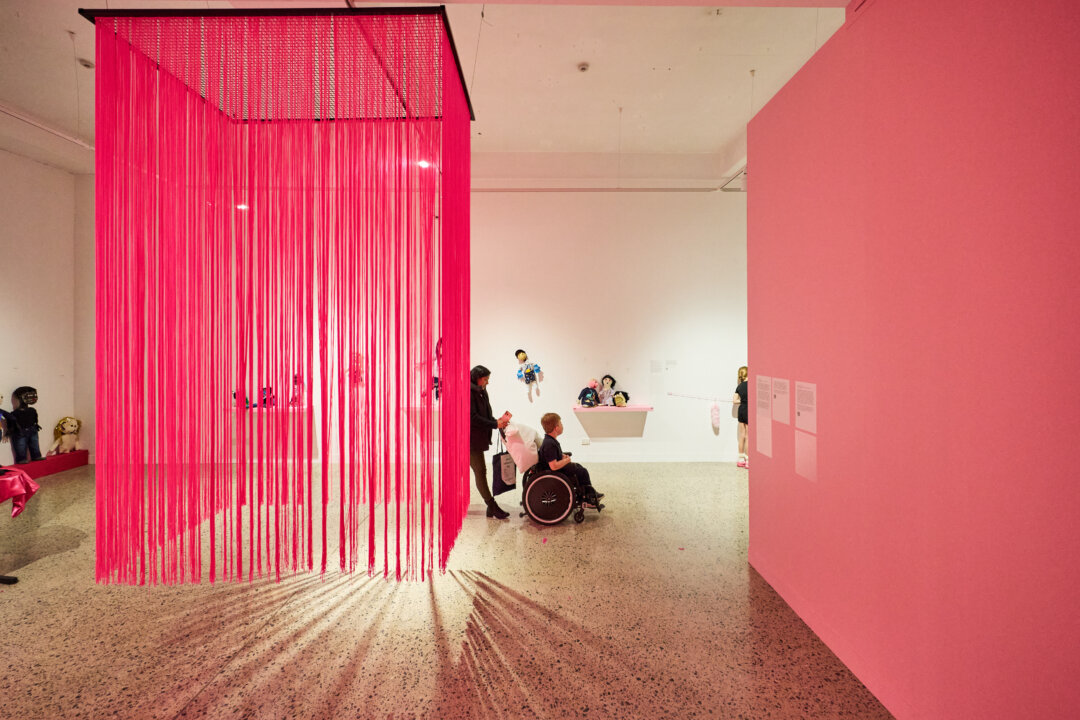
A person pushes a young person in a wheel chair through a gallery with pink walls. They are passing an artwork of pink fabric threads hanging down from the ceiling.

Addressing visual arts’ bias towards sight. “While works involving sound, touch and even scent are now part of expanded, post-medium art practices, art remains primarily a visual medium,” Shan Michaels puts accessibility at the heart of her work.

By art historian, writer, curator and researcher based in Brisbane/Meanjin, Dr Bree Di Mattina.

Galleries and museums are exalted realms devoted to collecting, preservation and conservation of cultural and historical objects. Exhibiting of pieces is beholden to these three drivers, the length and mode of showcasing works dependant on their preservation and conservation needs. It is due to these concerns that sight rather than touch is the primary sense with which art, or using the historical term ‘visual art’, is usually consumed. While works involving sound, touch and even scent are now part of expanded, post-medium art practices, art remains primarily a visual medium.

The necessary physical requirements and restrictions in museums and galleries subsequently reinforce sensorial hierarchies, promoting the primacy of sight over other senses. Termed ocularcentrism, it is the cultural, philosophical and biological bias towards sight. Sight is often also linked to truth and reason, articulated through adages such as ‘seeing is believing’. Sight allows the viewer to perceive the world, take in the details, assess the situation, while maintaining detachment and distance. Yet heavy reliance on sight prevents embodied engagement, activation of the other senses and immersion in experiences. French philosopher and feminist Luce Irigaray proposed that to counter the distance and objectification promoted by reliance on vision, a return to the tactile would promote proximity, coexistence and empathy.

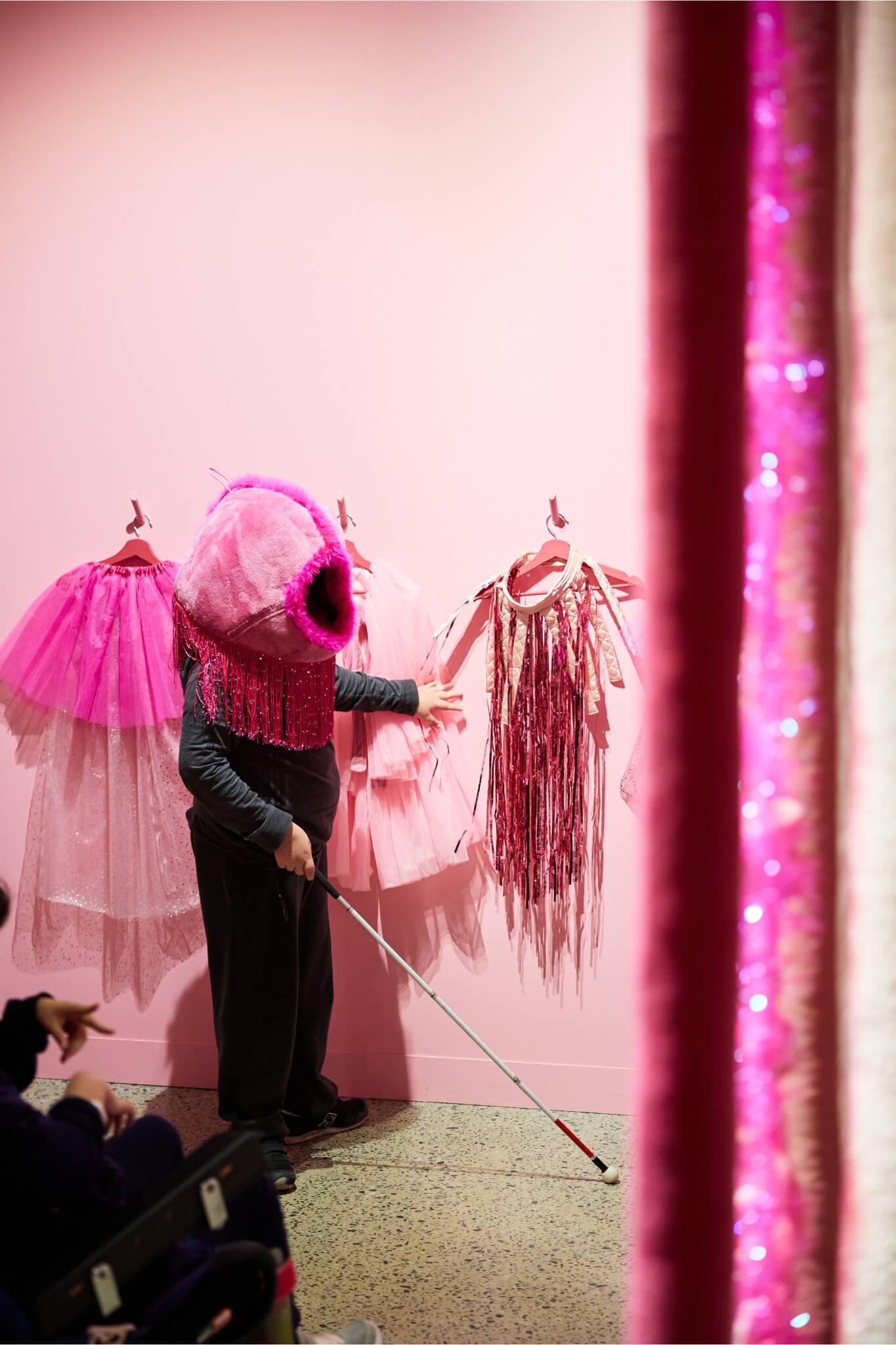
Inside a gallery with pink walls a person dressed in dark clothes using a BLV cane reaches out to touch differently textured costumes hanging on the wall. He wears a large pink fluffy ball-shaped mask/hat that covers his whole head. Shiny pink suspended fabric strips hang in the foreground.

As an artist, a queer woman and the mother of a child with low vision, Shan Michaels became acutely aware of the gaps in arts accessibility for the blind and low vision (BLV) community. To counter this lack, rather than making works and then retrofitting accessibility solutions, Michaels puts accessibility at the heart of her pieces, taking accessibility as her core concern and methodology. Michaels’ practice shows what art can be if not primarily tethered to the sense of sight but allowed to develop in a more accessible, embodied and sensorially-holistic manner.

Shan Michaels stands facing the camera in a relaxed pose with her hands in her pockets, positioned in the centre of the frame. She is standing in a gallery with soft, neutral lighting, surrounded by bright and colourful artworks on the walls and floor.

First exhibited at Adelaide Contemporary Experimental in 2025, Can Touch This (2025) is an immersive installation. Swathes of textiles in varying textures hang from the ceiling, which visitors are encouraged to move through, drape around themselves and experience in a body-enveloping way. Thin, thick, plaited, knotted, stuffed, furry and sequined, the abundant and varied textiles cascade from above, keeping the floor free from hazards. Away from the forest of texture, foam furniture and soft sculptural elements provide further space to build, climb or just to relax. Drawing inspiration from making with her daughter, Michaels collaborated with students from the South Australian School and Services for the Vision Impaired (SASSVI), who contributed to the making of the textile pieces, creating an artistic experience for everyone to enjoy. The monochromatic colour palette, a riot of bright pinks, while fun also serves to deprioritise the reliance on sight by interrupting normal visual cues gained through perception of colour. Instead, visitors are enticed to investigate the textural qualities of the elements through touch and embodied experience. Lining the wall is a series of costumes, which visitors are invited to don as they move through the space, further enhancing the immersive nature. Adding to the multi-sensory experience, accompanying the installation is a three-movement soundtrack composed by Antony Abbracciavento, a South Australian musician who has been blind since birth. His composition further enhances the total sensorial experience of the installation. Expected elements like floorplans and didactic panels are also presented in braille and text.


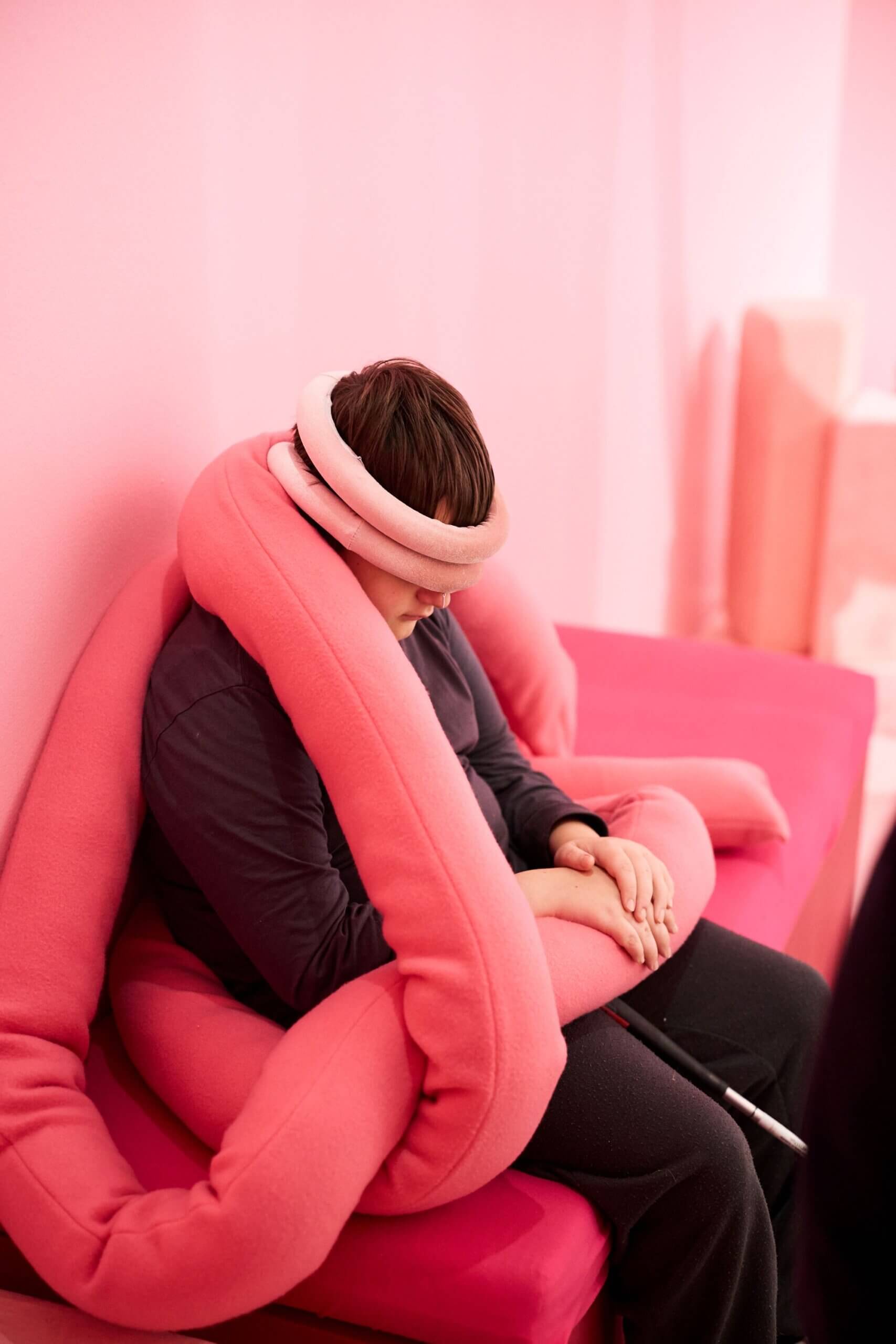
The gallery space has a pink wall and soft pink seat with a person dressed in dark clothes wrapped in a thick soft pink fabric tube. The soft tube looks like it is hugging him.

From its cheeky title to the riot of materials and bright palette, Can Touch This is a whole-body immersion in multi-sensory fun. It is also a serious reflection on accessibility, in both museums and galleries, and the world in general. Long deterred from the enjoyment of a museum or gallery due to the sight-laden nature of art, Michaels worked alongside the blind and low vision community, putting them at the heart of this artwork. Together, by approaching the artistic process through the diverse ways in which her collaborators explore, experience and understand the world around them, new artistic possibilities were unlocked, and they created an experience everyone can enjoy. Through Can Touch This Michaels shows that accessibility, rather than a piecemeal afterthought, can be a methodological process through which great art experiences are created.

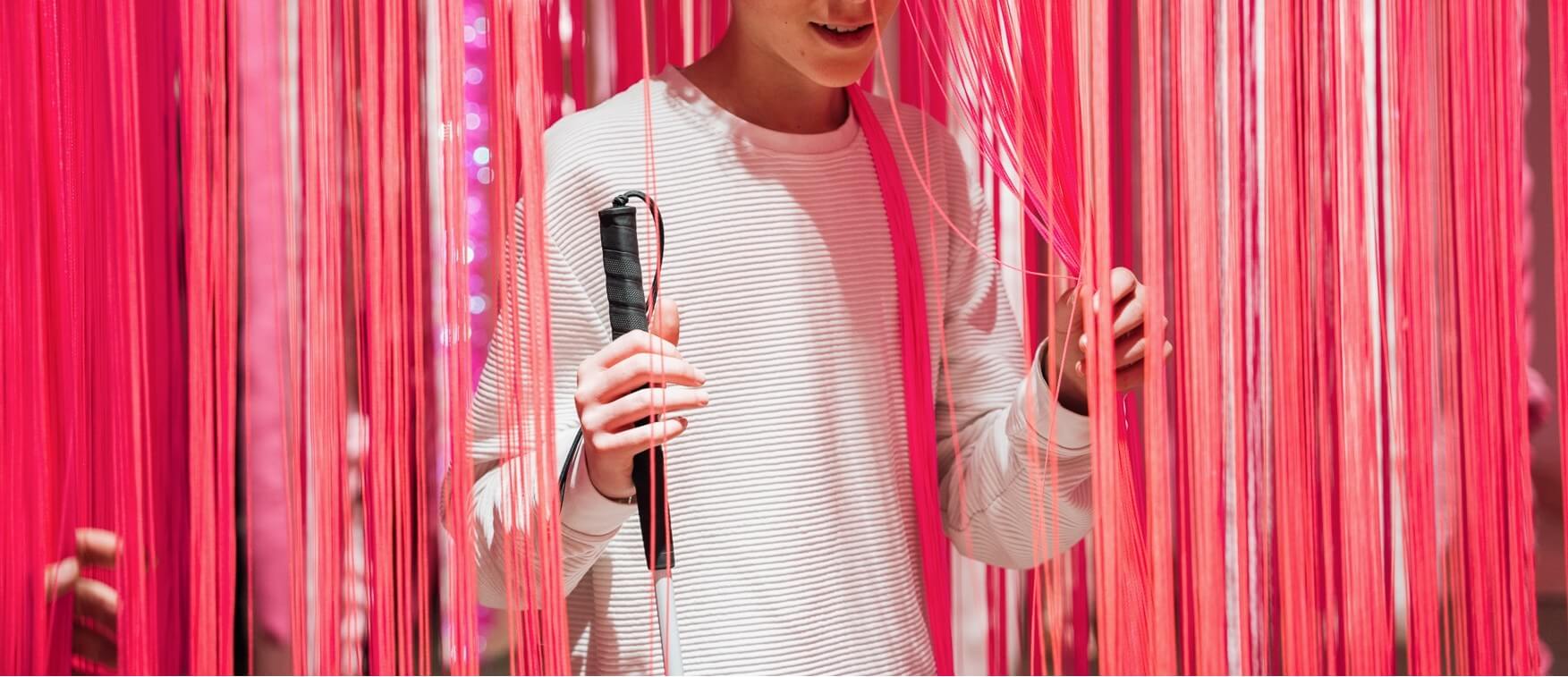
A person explores an immersive installation of hanging bright pink threads, holding a white cane as they move through the artwork.

Acknowledgements

Presented in partnership with Adelaide Contemporary Experimental (ACE). Can Touch This was developed with South Australian textile artists and the BVI community.

This project is supported by the 2026 Brisbane Airport Community Giving Fund.

Metro Arts’ 2026 program is supported by the Australian Government through Creative Australia, its funding and advisory body. Metro Arts is supported by the Queensland Government through Arts Queensland and the Visual Art, Craft and Design Framework, an initiative of the Australian, state and territory governments.

ACE logo

Images

Photography taken at Adelaide Contemporary Experimental (2025) by Andre Castellucci @andre_c, except where otherwise noted.

Image 1 (header) A person pushes a young person in a wheel chair through a gallery with pink walls and soft, dim lighting. They are surrounded by artworks and are interacting with pink fabric tubes that are hanging down from the ceiling.

Image 2 Inside a gallery with pink walls A person dressed in dark clothes using a BLV cane reaches out to touch differently textured costumes hanging on the wall. He wears a large pink fluffy ball-shaped mask/hat that covers his whole hear. Shiny pink suspended fabric strips hang in the foreground.

Image 3 Shan Michaels wearing a brightly coloured dress, standing in her exhibition next to a textile art work on the floor. Photo by Embellysh.

Image 4 Can Touch This participant wrapped in soft pink tube, Adelaide Contemporary Experimental.

Image 5 Participant explores art installation of hanging bright pink threads, holding a white cane as they move through the artwork. Shan Michaels, Can Touch This
 

Support Us